Application of the Generative Artificial Intelligence in Subsea Engineering Based on Outcome Based Education
Case Study of Subsea Engineering at UTM, Malaysia
Abstract
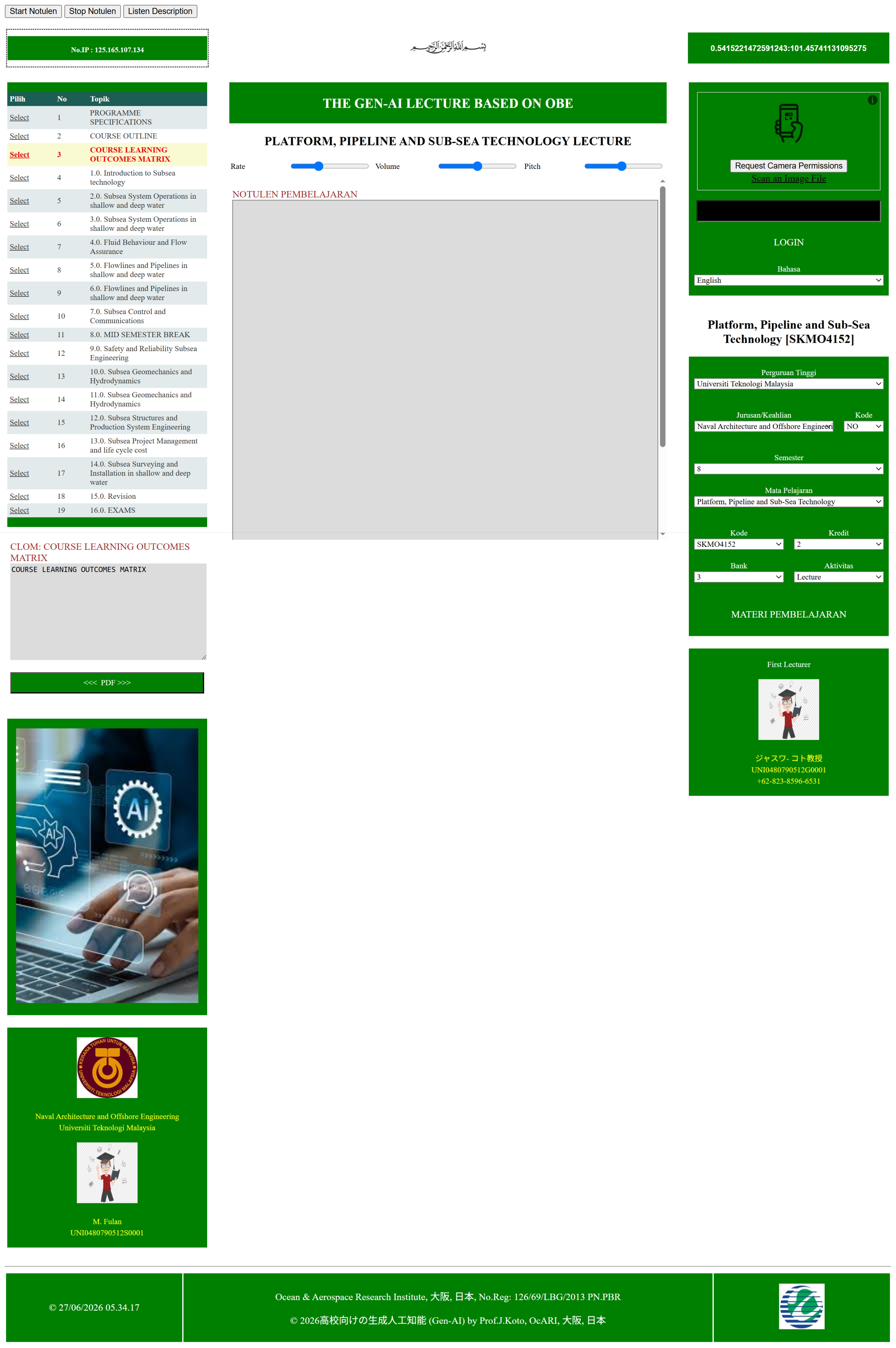
This study explores the integration of The OcARI Generative Artificial Intelligence (The OcARI Gen-AI) within the Outcome-Based Education (OBE) framework in undergraduate subsea courses. The findings indicate that the enhanced OBE model utilizing The OcARI Gen-AI significantly outperforms the traditional OBE approach, particularly in boosting student performance and increasing the proportion of high-achieving students in Subsea Engineering studies. The OcARI Gen-AI plays a crucial role in addressing the challenges faced by Indonesia's traditional OBE-based education system by enabling students to learn anytime, anywhere, and on any device. Furthermore, it allows for the minimization of educational costs while simultaneously making the process more effective, accurate, and transparent.
Downloads
References
2. Ihsan Arbiyanta, 2025, Tantangan Pendidikan di Era Modern: Kajian Isu Strategis dan Implikasinya bagi Sistem Pendidikan Indonesia, Jurnal Ilmiah WUNY, Vol 7, No 2 (2025)
3. Annisa Az Zahra, et.al, 2026, Tantangan dan Strategi Pendidikan Karakter di Daerah Tertinggal, Terdepan, dan Terluar (3T): Studi Systematic Literature Review, Vol. 1 No. 2 (2025): Serambi Pendidikan: Jurnal Pendidikan Islam.
4. OECD, 2023, PISA 2022 Results (Volume I and II) ? Country Notes: Indonesia, https://www.oecd.org/en/publications/pisa-2022-results-volume-i-and-ii-country-notes_ed6fbcc5-en/indonesia_c2e1ae0e-en.html
5. Ashabul Yamin, Fitra Jayadi, 2026, Gen Z Dominasi Penduduk Indonesia, Jadi Penentu Masa Depan Bangsa, RRI, https://rri.co.id/takengon/nasional/2509696/gen-z-dominasi-penduduk-indonesia-jadi-penentu-masa-depan-bangsa#google_vignette
6. Kania Aisha Pasaman, 2024, Indonesia GEN Z Report 2024, Understanding and Uncovering the Behavior, Challenges, and Opportunities, IDN Research Institute. https://cdn.idntimes.com/content-documents/indonesia-gen-z-report-2024.pdf
7. Petir Garda Bhwana, 2024, Nearly 10 Million Indonesian Gen Z Unemployed; Manpower Ministry Responds, Tempo, https://en.tempo.co/read/1870901/nearly-10-million-indonesian-gen-z-unemployed-manpower-ministry-responds
8. Tooba Sikander, et.al, 2017, Continuous Quality Improvement (CQI) Framework: A Case of Industrial Engineering Department, Vol. 5, No.1, 2017, International Journal of Cognitive Research in Science, Engineering and Education.
9. UTM, 2015, Bachelor of Engineering (Naval Architecture and Offshore Engineering) Programme Specifications https://mech.utm.my/undergraduate/wp-content/uploads/sites/6/2015/03/Program-Specification-SKMO.pdf
10. Yuanyuan Cao, Yitao Liu, Jinwen Lai. (2005). “Leveraging Artificial Intelligence in Outcome-Based Education: A Case Study of Undergraduate Auditing Curriculum.” Advances in Applied Sociology, 2025, 15(2), 60-74 [https://www.scirp.org/pdf/aasoci2025152_22292171.pdf].
11. N. Pradeesh M.G. Thushara. 2025, AI-Driven Personalized Learning and Remedial Recommendation through Knowledge Concept-Centric Evaluation, Digital Object Identifier 10.1109/ACCESS.2025.3638427.
12. Hu Wang, Geng'e Zhang, Zehui Li, Xiaozhe Yang. (2026), “An AI-Enhanced Teaching Framework Integrating OBE and Five Pillars of Education for Project-Based Practical Training.” ICBDIE '26: Proceedings of the 2026 International Conference on Big Data and Informatization Education Pages 1289 - 1294, https://doi.org/10.1145/3806980.3807180.
13. Rongxin Chen, Zongyue Wang, Zhihua Wang, Zhijin Wang (2026), AI-enabled teaching reform of programming courses based on OBE. IECA 2026: 2026 3rd International Conference on Informatics Education and Computer Technology Applications Pages 868 - 874, https://doi.org/10.1145/3802133.3802273.
14. Jaswar Koto, 2026, Mengenal Sistem Pembelajaran Berbasis AI dengan Metode “Outcome Based Education”, Institut Media Digital Emtek, https://maukuliah.id/universities/institut-media-digital-emtek/articles/mengenal-sistem-pembelajaran-berbasis-ai-dengan-metode-outcome-based-education.
15. Jaswar Koto. 2026. Pemanfaatan AI dalam Pendidikan & Analisis Laporan Keuangan. WEBINAR IAIS DATA SCIENCE SERIES 2025, Indonesia Artificial Intelligence Society (IAIS).
16. Jaswar Koto. 2025. Artificial Intelligence (AI) dalam Pendidikan. - Dialog Interaktif Luar Studio Pro 1 RRI Pekanbaru,https://www.youtube.com/watch?v=9Wg7Jab1TUg
17. Jaswar Koto. 2025. Timbangan AI, Pemkab Kampar Dukung Penuh Inovasi Bisnis Kambing Terpadu Berbasis AI. https://mediacenter.kamparkab.go.id/artikel-detail/4701/pemkab-kampar-dukung-penuh-inovasi-bisnis-kambing-terpadu-berbasis-ai
18. Jaswar Koto. 2025. Mengenal Sistem Pembelajaran Berbasis AI dengan Metode Outcome Based Education. Kolaborasi Liputan 6 SCTV-IMDE https://www.merdeka.com/peristiwa/kolaborasi-liputan-6-sctv-imde-mengenal-sistem-pembelajaran-berbasis-ai-dengan-metode-outcome-based-education-388487-mvk.html?page=2
19. Feri Johansah, Jaswar Koto, 2023, Hubungan AI, Neuropsikologi, dan Agama, Pasundan News.com, https://pasundannews.com/hubungan-ai-neuropsikologi-dan-agama-ini-penjelasan-prof-dr-eng-jaswar-koto/




