Analyzed Mooring of Rounded-Shape FPSO using Lumped Method
Abstract
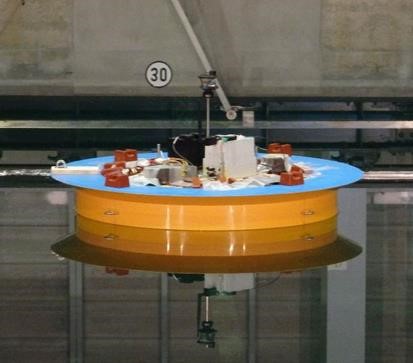
Mooring line is functionally to maintain the position of floating structure under normal operating load and extreme storm load conditions. This paper discussed on mooring line of rounded-shape FPSO. Preparation procedures such as mooring design process and model setup were carried out. Mooring design process includes analysis displacement of taut mooring based on Lumped method. Simulation software based on the Lumped method was written in Visual Basic language called Finite Element on Mooring and Riser. The basin tank experiment also was conducted to study the hydrodynamic characteristic of the round-shape FPSO. In the experiment, the FPSO model is constructed based on scale ratio 1:110 and it is installed in wave dynamic tank with model size mooring lines.
Downloads
References
2. Arslan, T., Pettersen, B. and Andersson, H.I. (2011). Calculation of the Flow Around Two Interacting Ships, Computational Methods in Marine Engineering IV, L.Eça, E. Oñate, J. García, T. Kvamsdal and P. Bergan (Eds.), pp. 254-265.
3. Afrizal, E., Mufti, F.M., Siow, C.L. and Jaswar. (2013). Study of Fluid Flow Characteristic around Rounded-Shape FPSO Using RANS Method. The 8th International Conference on Numerical Analysis in Engineering: 46 – 56. Pekanbaru, Indonesia.
4. Srinivasan et al. (2008). Design of Non-Ship-Shape FPSO for Sakhalin-V Deepwater, SPE Russion Oil and Gas Technical Conference and Exhibition, 28-30 October, Moscow, Russia.
5. Wang, T. Y., Zhang, J., and Liu, J. K. (2012). Concept Design of a New Non-Ship-Shaped FPSO, Applied Mechanics and Materials, Vol. 170-173, pp. 2222-2227.
6. Siow, C. L., Jaswar, K, and Khairuddin, N.M. (2014). Study on Model Scale Rounded-Shape FPSO’s Mooring Lines, Journal of Ocean, Mechanical and Aerospace Science and Engineering, Vol. 12, pp.1-6.
7. C. L. Siow, J. Koto, H. Yasukawa, A. Matsuda, D. Terada, C. Guedes Soares, Muhamad Zameri bin Mat Samad, 2014, Experiment Study on Hydrodynamics Characteristic of Rounded- Shape FPSO, The 1st Conference on Ocean, Mechanical and Aerospace -science and engineering-. Pekanbaru, Indonesia.
8. Siow, C.L., Koto, J., Yasukawa, H., Matsuda, A., Terada, D., Soares, C.G., Incecik, A., Pauzi, M.A.G. (2015). Mooring Effect on Wave Frequency Response of Round Shape FPSO. Jurnal Teknologi, Vol 74, No 5, pp.59-68
9. Siow, C.L., Koto, J., Yasukawa, H., Matsuda, A., Terada, D., Abyn, H. (2016). Investigation Motion Responses of Ship Shape Floating Structure using Diffraction Potential. Journal of Subsea and Offshore -Science and Engineering-, Vol.5
10. Koto, J., Siow, C. L., Khairuddin, Afrizal, N. M., Abyn, H., Soares, C. G. 2014. Comparison of Floating Structures Motion Prediction between Diffraction, Diffraction-viscous and Diffraction-Morison Methods. The 2nd International Conference on Maritime Technology and Engineering. Lisboa, Portugal.
11. Siow, C.L, Koto, J, Abby, H. Khairuddin, N.M, 2014, Prediction of semi-submersible's motion response by using diffraction potential theory and heave viscous damping correction, Jurnal Teknologi (Sciences and Engineering), Vol.69, No.7, 2014, pp.127-133.




