A Prototype of Salt Gradien Solar Pon as Alternative Energy Source for Coastal Communities in Bengkulu
Abstract
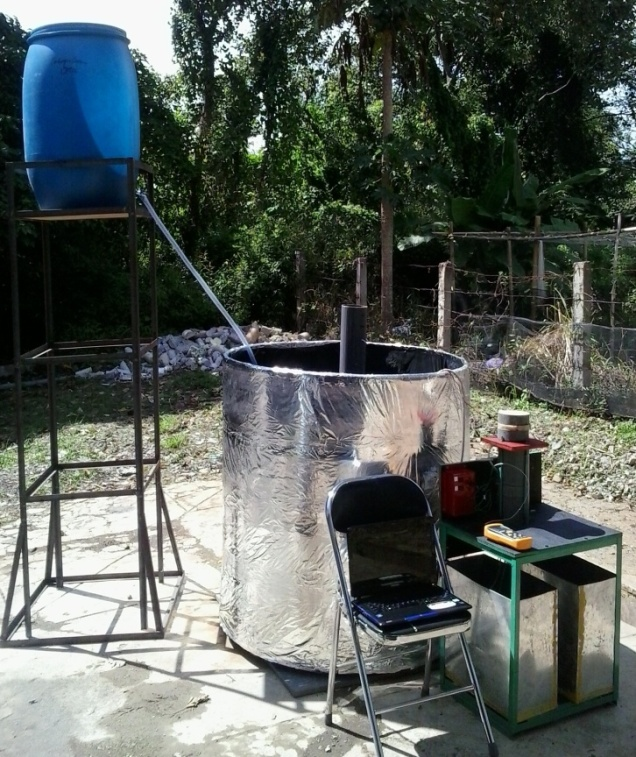
One of the developing technologies of renewable energy is the Salt Gradient Solar Pond (SGSP). SGSP utilize solar energy by storing its thermal energy in a pond of saline solution. Bengkulu Province has a high intensity of sunlights and a long coastline with abundance of salt water. Therefore, it is a very suitable location for further development of SGSP technology. The design of SGSP prototype had been carried out by using a 1 m3 cylinder as the saline solution pond. The density and temperature of the solution were measured at 11 points from the bottom to the top of the cylinder. The results show that the deeper of the pond the more density of the solution, in which the highest solution density was at the bottom of the pond, i.e. 1.206 gr/cm3. The average temperature of the solution was 44.2°C. The maximum temperature, which was 48.7 °C, was observed around the storage zone, about 0.3 m from the pond‘s bottom. The results of the measurements of salinity gradient and temperatures show that this prototype of SGSP is appropriate to be used for storing heat around the storage zone.
Downloads
References
2. Indartono, Y.S. (2010). Energy dan Perubahan Iklim, Program Studi Teknik Mesin ITB.
3. Rashid. F.L., Fayyadh. I. K., and Hashim. A. (2012). Design of Solar Pond for Electricity Production, British Journal of Science Vol. 3 (2), pp: 104-110.
4. Akbarzadeh, A., Andrews, J., Golding, P., Solar Ponds., Solar Energy Conversion and Photoenergy Systems, Vol. 1.
5. Valderrama, C., Gibert, O., Arcal, J., Solano., Akbarzadeh, A., Larrotcha, E., Cortina, J.L. (2011) Solar Energy Storage by Salinity Gradient Solar Pond: Pilot Plant Construction and Gradient Control., Desalination Vol. 279 (1-3), pp: 445-450.
6. Srinivasan. J. (1993) Solar Pond Technology. Sadhana. Vol 18. Part 1, pp: 39-55.
7. Singh. R., Tundee.S., Akbarzadeh. A. (2011). Electric Power Generation From Solar Pond Using Combined Thermosyphon and Thermoelectric Modules, Solar Energy Vol. 85 (2), pp: 371-378.
8. Jaefarzadeh.M.R. (2004). Thermal Behavior of a Small Salinity-Gradient Solar Pond with Wall Shading Effect, Solar Energy Vol. 77 (3). pp: 281-290.
9. Egbe. J.G., Khan.A.H., Wisatesajja. W. (2013). Design of Solar Pond Calculation and Technique in Africa, IOSR Journal of Mechanical and Civil Engineering Vol. 6 (1), pp: 22-32.
10. Sharif, A. O., Al-Husaini- H., Alenezi, I.A. (2011). New Method for Predicting the Performance of Solar Pond in any Sunny Part of the World. World Renewable Energy Congress-Solar Thermal Applications, Sweden.
11. Lu, H., Walton, J.C., Swift, A. H. P. (2001). Desalination Coupeld with Salinity-Gradient Solar Ponds, Desalination Vol. 136 (1-3), pp: 13-23






